The Church of England plays a vital role in
the life of the nation, proclaiming the Christian gospel in words
and actions and providing services of Christian worship and
praise.
Its network of parishes cover the country, bringing a
vital Christian dimension to the nation as well as strengthening
community life in numerous urban, suburban and rural settings. Its
cathedrals are centres of spirituality and service, and its network
of chaplaincies across continental Europe meet important local
needs.
The Church of England plays an active role in national
life with its members involved in a wide range of public bodies.
Twenty-six bishops are members of the House of Lords and are
engaged in debates about legislation and national and international
affairs.
The Church of England is part of the worldwide Anglican
Communion.
Key facts about the Church of
England:
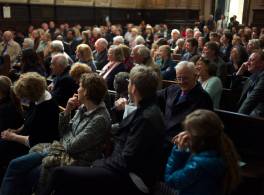
Church attendance and visits
- 1.7 million people take
part in a Church of England service each month, a level that has
been maintained since the turn of the millennium. Approximately one
million participate each Sunday.
- Approaching 3 million people participate
in a Church of England service on Christmas Day or Christmas Eve.
Thirty-five per cent of the
population attend a Christmas service of some sort, rising to 42
per cent in London, nationally, and 22 per cent among those of
non-Christian faiths.
- The Church of England has the largest following of any
denomination or faith in Britain today. More than 4 in 10
in England regard themselves as belonging to the Church of
England, while 6 in 10 consider themselves Christian.
- People support their local churches in many different
ways at different points in their lives. Each year 3 in 10
attend regular Sunday worship and more than 4 in 10 attend
a wedding in their local church, while still more attend a funeral
there
- In 2009, 43 per cent of adults attended
a church or place of worship for a memorial service for someone who
has died and 17 per cent were seeking a quiet
space. Both these proportions are increases on 22 per cent
and 12 per cent respectively in 2001.
- 85 per cent of the
population visit a church or place of worship in the course of
a year, for reasons ranging from participating in worship to
attending social events or simply wanting a quiet
space.
- Every year, around 12 million people
visit Church of England cathedrals, including
300,000 pupils on school visits. Three of
England's top five historic 'visitor attractions' are York Minster,
Canterbury Cathedral and Westminster Abbey.
Education
- Seven in ten (72%) of the
population agree that Church of England schools help young people
to grow into responsible members of society and 8 in
10 (80%) agree that they promote good behaviour and
positive attitudes.
- Latest available statistics indicate one in
four primary schools and one in 16
secondary schools in England are Church of England schools.
Approaching one million pupils are educated in
more than 4,700 Church of England schools.
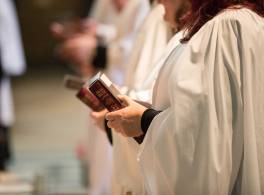
Ministers
- At the end of 2009, there were 19,504 ministers licensed
by Church of England dioceses, including clergy, readers and Church
Army officers: one minister for every 2,500 people in England. The
total does not include more than 1,600
chaplains to prisons, hospitals, the armed forces and in education,
nor around 7,190 retired ministers with permission
to officiate.
- The Church recommended 491
future clergy for ordination training in 2009,
maintaining the level at the turn of the millennium.
- It ordained 564 new clergy in 2009
Overall, 266 women and 298 men were ordained in 2009, with more
than half ordained to full-time, stipendiary ministry: 193 men and
116 women.
Community involvement
- More people do unpaid work for church
organisations than any other
organisation. Eight per cent of adults
undertake voluntary work for church organisations while sixteen per
cent of adults belong to religious or church
organisations.
- A quarter of regular churchgoers (among both Anglicans
and other Christians separately) are involved in voluntary
community service outside the church. Churchgoers overall
contribute 23.2 million hours voluntary service
each month in their local communities outside the
church.
- The Church of England provides activities outside church
worship in the local community for 407,000 children and
young people (aged under 16 years) and 32,900 young people
(aged 16 to 25 years). More than 116,000
volunteers and an additional 4900 employed adults run
children/young people activity groups sponsored by the Church of
England outside church worship.
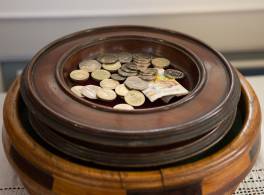
- Church of England congregations give more than
£51.7 million each year to other charities -
that's even more than the BBC's annual Children in Need
appeal.
- More than half a million worshippers
subscribe to tax-efficient giving schemes such as Gift Aid,
accounting for half the voluntary income of parish
churches.
Church buildings
- Nearly half the population
(46%) think that central taxation, local taxation, the
National Lottery or English Heritage should be 'primarily'
responsible for providing money to maintain churches and chapels.
These churches and cathedrals are largely supported by the efforts
and financial support of local communities. Often, they are the
focus of community life and service.
- There are 14,500 places of worship in England listed for
their special architectural or historic interest, 85% of
which belong to and are maintained by the Church of
England.
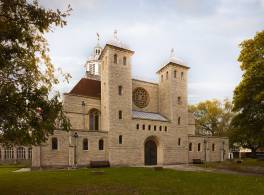
- The Church of England has more than 16,000
churches, serving every inch of the country and open to
every local inhabitant. There are 42 mainland
cathedrals, plus one in Peel on the Isle of Man
and the Diocese in Europe's cathedral in Gibraltar.
- People value their local church and 68%
consider it an important part of their local
community. Those who consider churches important include
45% of people with no religion and 62% of adherents of other
faiths. 70% believe it provides valuable social and community
facilities and 57% believe it should be more actively involved in
the local community.
- Three church and cathedral locations are World
Heritage Sites: Durham Castle and Cathedral, Canterbury
Cathedral, St Augustine's Abbey & St Martin's Church, and
Westminster Abbey and St Margaret's Church.
- In 2006, necessary repairs to all listed places of
worship in England were valued at £925m over the next five years,
or £185m a year. Around £110 million is currently spent on
repairs to Church of England churches per annum, 70% of it
raised by the congregations and local community.
Sources:
Church Statistics 2003/4, 2004/5, 2006/7, 2007/8, 2008/9
and 2009/10
Opinion Research Business national polls
2000-2009
English Heritage and Church of England Cathedral and
Church Buildings Division Joint Research 2006
Church Life Survey 2001